

On the morning of 12 January 2024, the United States and Britain, with support from Australia, Bahrain, Canada, and the Netherlands, launched a series of cruise missile and airstrikes against some 60 Houthi (Ansar Allah) targets across Yemen in an attempt to check their attacks on ships in the Red Sea. In spite of claiming self-defence, the “freedom and democracy” enforcement squad conducted the attacks unilaterally, without a UN Security Council resolution. In doing so, they’ve exacerbated the risks of an escalation to a wider regional war with unpredictable consequences.

An escalation could have a severe impact on oil prices, deepening the energy crisis in the West. In fact, this was one of the concerns of many observers and the producer with Sputnik News reached out to me to comment on this. However, my response wasn’t exactly a standard fare commentary, but it does reflect my nearly 30 years’ experience in commodities markets.
First, ignore the hype
To be sure, the geopolitical events in West Asia could push oil prices higher, but we should not assume that they necessarily will. There could be a spike upward in the short term, but whether the upward pressure on prices will be sustained is an open question. This will depend on the way the situation evolves. If tensions escalate, we’ll almost certainly see oil prices increase sharply.
In these situations, market analysts and the commentariat tend to generate a blizzard of extraordinary predictions and hype, but we should be cautious with any sensational interpretations of what’s to come.
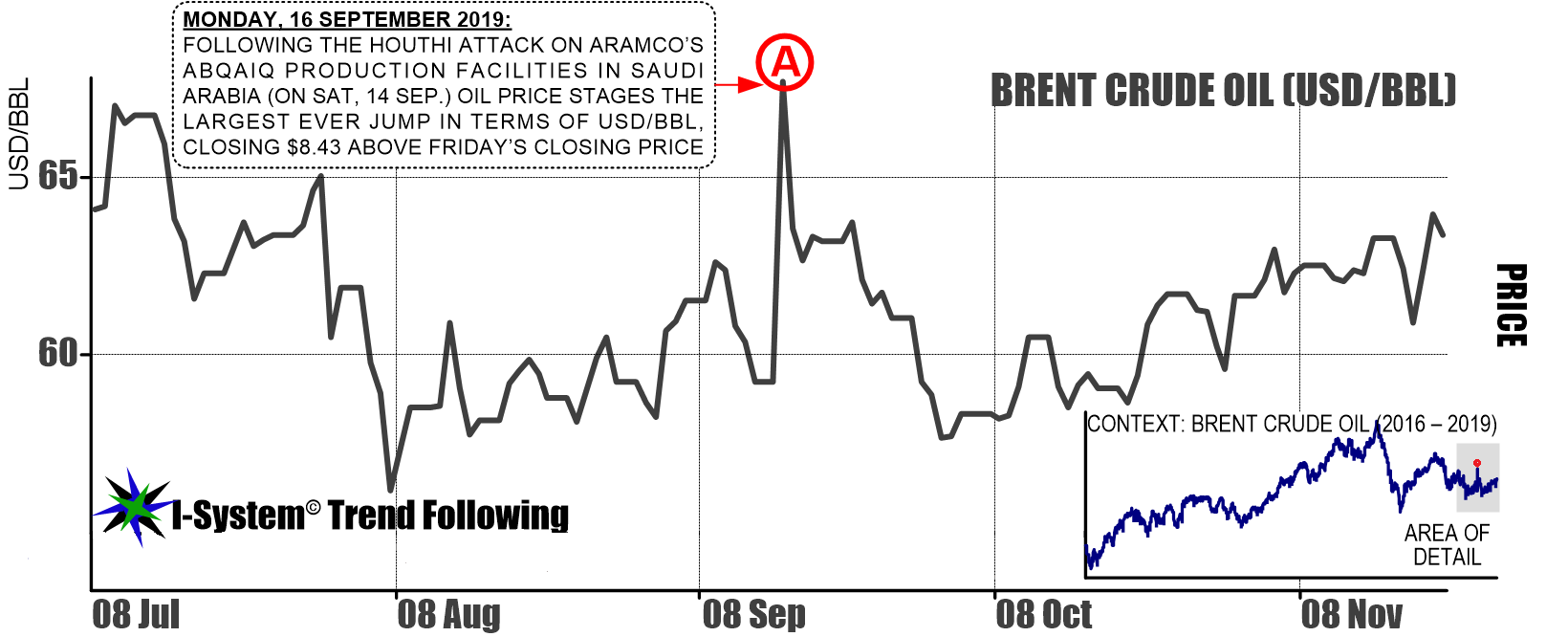
For example,on Saturday, 14 September 2019 a missile attack on Saudi Arabia caused substantial damage to Aramco’s Abqaiq oil production facilities. The following Monday, Brent crude oil experienced the largest-ever one-day price jump, reaching $70.32 during the day and closing at $67.78 – $8.42/bbl above previous Friday’s closing price ($59.25/bbl).
This event is marked as (A) in the chart below. Fearing further escalations, many market participants expected that the price would rapidly move toward $100/bbl but this did not happen. Instead, the price quickly dropped back below $60/bbl and continued to fluctuate between the high $50s and low $60s for the rest of the year:
In 2020, entirely different circumstances evolved with the pronouncement of the Covid 19 pandemic, which had a different impact on oil prices altogether:
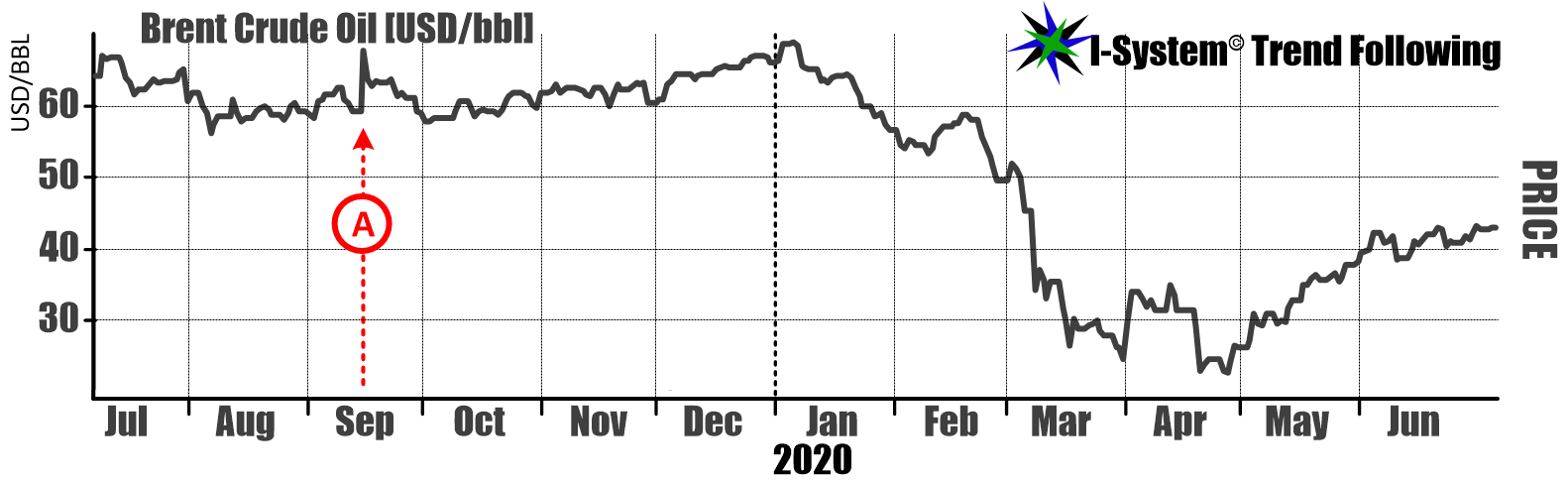
Seen in this perspective, the September 2019 attack on Aramco facilities appears only as a blip on the historical price chart. For traders who got taken up by the day’s hype, anticipating a rapid ascent toward $100/bbl probably left them with crippling losses.
Prediction is difficult
As Niels Bohr, the nobel laureate in physics and father of the atomic model said, “Prediction is very difficult, especially if it’s about the future.” Bohr had it exactly correct. In addition to geopolitics and the supply and demand economics, oil prices are determined by a very complex confluence of factors that are almost impossible to account for.
During most of the last 20+ years, the most important single factor influencing oil prices has been the US dollar which has had a very strong inverse correlation to oil prices:
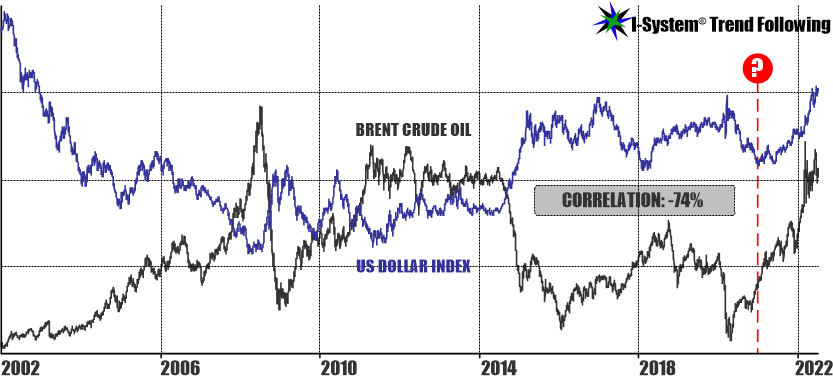
We can see that this correlation has broken down after 2021 (marked “?” in the chart), but it nevertheless tells us an important story: that of all factors impacting oil prices, the US dollar has been by far the most important one. This implies that factors like US economic performance, employment, inflation, Federal Reserve policy, and interest rates play a much greater role in determining the price of oil than do the discernible supply/demand economics and even geopolitics.
How to navigate the roller-coaster?
The next question is, how should market participants – investors, traders and hedgers – navigate the roller-coaster, since making predictions is out of the question? My own strong conviction is that the only way to navigate through uncertainty is through systematic trend following. The chart below illustrates how a set of I-System Trend Following strategies have performed during the 2019/2020 period:

I-System strategies are based entirely on the analysis of price fluctuations and are blind to factors like supply/demand fundamentals or geopolitics. As such, they can’t anticipate nor react to unpredictable events like the Abqaiq attack. But what is far more relevant to oil traders are the large-scale price events (LSPEs), which represent by far the greatest risk (and conversely the greatest opportunity) for oil-related businesses.
While we can’t predict the timing or the magnitude of LSPEs, we do know that they invariably unfold as trends, spanning weeks, months and even years. It follows that tracking the markets with a set of high quality trend following strategies will likely prove the most effective and most sustainable way to navigate them profitably, confidently and with peace of mind.

 I-System Trend Following